
Discover seven beautiful Bangladeshi crafts and the skilled artisans behind them. From Nakshi Kantha and handloom textiles to Shital Pati, jute and terracotta, every creation carries a story.
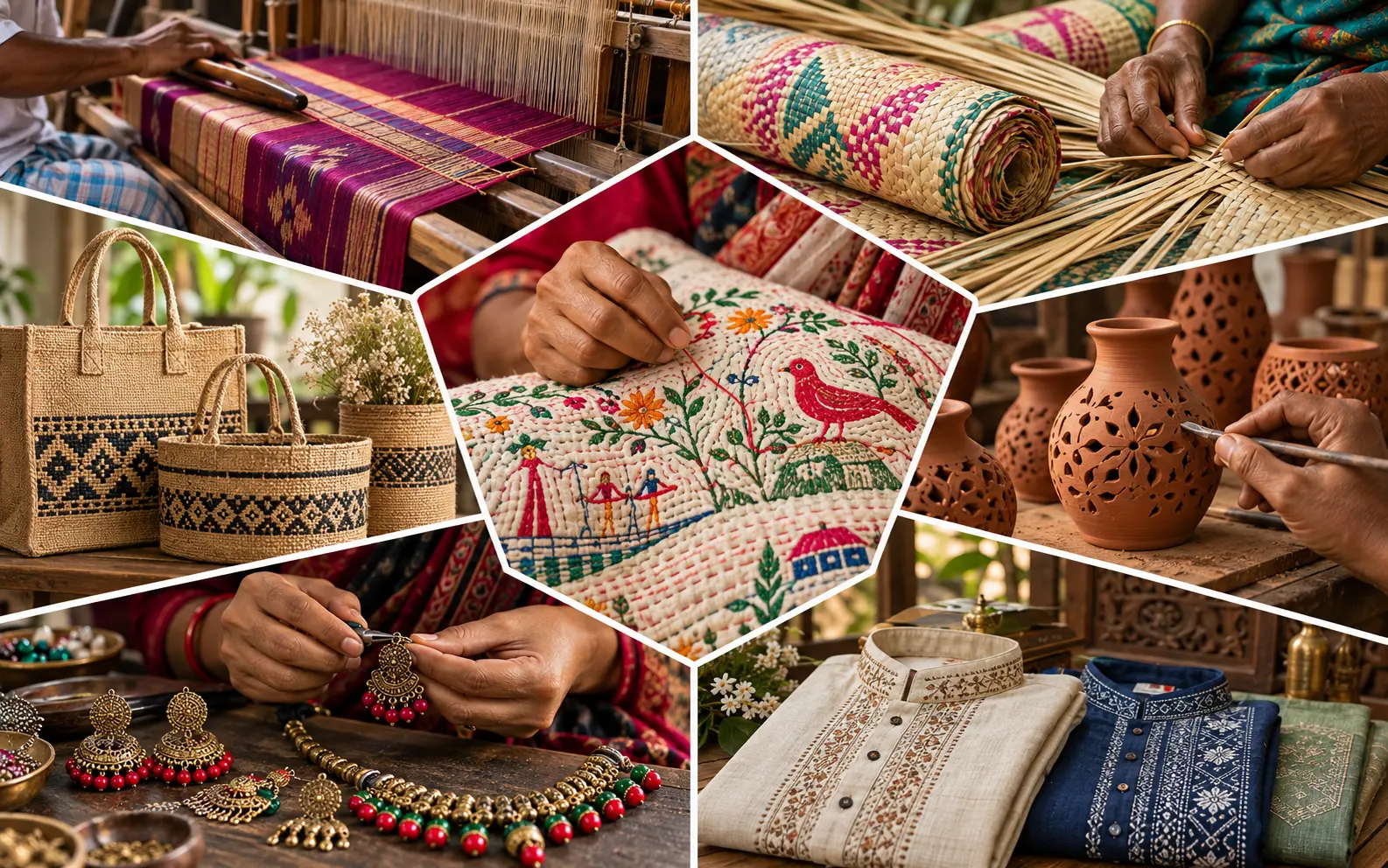
7 Traditional Bangladeshi Crafts and the Artisans Behind Them
Bangladesh is a land shaped by color, craft and skilled hands.
For generations, artisans across the country have transformed thread, clay, jute, natural fibres and fabric into products that are both useful and beautiful.
These are not simply handmade products.
They represent skill, tradition, patience and identity.
At AATCHALA, we believe every craft becomes more meaningful when we know something about the person behind it.
Here are seven forms of Bangladeshi craftsmanship we want more people to discover and celebrate.
1. Nakshi Kantha — Stories Stitched by Hand
A simple piece of fabric can become something extraordinary in the hands of a skilled artisan.
Nakshi Kantha is known for detailed hand stitching and decorative motifs that can transform layers of cloth into expressive works of craftsmanship.
Flowers, leaves, birds, geometric forms and scenes inspired by everyday life can all become part of a Kantha design.
But its beauty is not only in the finished pattern.
It is also in the hours of careful work behind every stitch.
At AATCHALA, we want customers to see more than a beautiful Kantha.
We want them to discover who stitched it, where it came from and how much time went into creating it.
2. Handloom Sarees — Beauty Woven Thread by Thread
There is something distinctive about fabric created on a loom.
The rhythm of weaving, the arrangement of threads and the artisan's experience gradually turn individual fibres into beautiful textiles.
Bangladesh has a rich handloom tradition that includes different styles of sarees and fabrics.
A handloom saree represents more than its color or pattern.
Behind it is a process requiring precision, patience and knowledge of weaving.
At AATCHALA, handloom products represent exactly what our brand stands for:
Craft with a human identity.
When you wear something handmade, you should have the opportunity to know the story behind its creation.
3. Shital Pati — Nature Woven into Craft
Some of the most beautiful Bangladeshi products begin with materials found in nature.
Shital Pati is a wonderful example.
Skilled artisans carefully prepare natural fibres and weave them into mats and decorative pieces featuring clean patterns and beautiful textures.
The process requires far more than simply weaving.
Preparing materials, creating an even structure and forming patterns all depend on experience.
Today, this traditional craft can also inspire contemporary products for:
- Floor décor
- Wall décor
- Table settings
- Home accessories
- Traditional interiors
It is where heritage and modern living can beautifully meet.
4. Jute Craft — Bangladesh's Golden Fibre Reimagined
Jute has long been closely connected with Bangladesh.
In the hands of creative artisans, this natural fibre can become much more than raw material.
It can become:
Baskets. Bags. Rugs. Storage. Décor. Accessories.
Jute craft has a natural texture that works beautifully in both traditional and contemporary homes.
What makes it even more interesting is its versatility.
A skilled maker can shape and weave the same material into products with completely different purposes.
At AATCHALA, we want to celebrate that transformation—from natural fibre to meaningful handmade design.
5. Terracotta — Art Shaped from Earth
Clay is one of the simplest natural materials.
But in skilled hands, it can take almost endless forms.
Traditional terracotta craftsmanship transforms earth into decorative and functional objects through shaping, detailing and firing.
The result may be a:
- Decorative pot
- Wall piece
- Showpiece
- Planter
- Home accent
- Traditional ornament
Each piece begins with something incredibly simple—clay.
What gives it character is the artisan.
The curves, textures, patterns and finishing all carry evidence of the human hands that shaped them.
That is exactly why handmade terracotta fits naturally within the AATCHALA story.
6. Handmade Jewellery — Small Pieces, Detailed Craftsmanship
Craftsmanship does not need to be large to tell a story.
Sometimes it appears in the smallest details.
Handmade jewellery can combine materials, colors and traditional inspiration to create pieces with their own individual character.
Earrings, necklaces, bracelets and accessories can all carry the personal touch of their maker.
Terracotta jewellery, handcrafted beads and other artisan-made designs also give customers an alternative to factory-produced accessories.
A handmade piece may not look perfectly identical to another.
And that is part of its charm.
Handmade means someone shaped it.
Someone assembled it.
Someone gave it its final character.
7. Handcrafted Panjabi — Tradition You Can Wear
Traditional clothing is another important expression of Bangladeshi craftsmanship.
A well-made Panjabi combines fabric, cutting, stitching and sometimes embroidery or handcrafted decorative details.
Handloom fabrics and traditional patterns can make these garments even more distinctive.
For us, clothing should not only represent fashion.
It can also represent craftsmanship and cultural identity.
A Panjabi made with careful attention to fabric and detail becomes something you can wear while staying connected to the craft behind it.
Every Craft Begins With an Artisan
Nakshi Kantha.
Handloom.
Shital Pati.
Jute.
Terracotta.
Jewellery.
Traditional clothing.
They may look completely different, but they all share one important thing:
Someone made them.
Behind every woven fibre, embroidered stitch and shaped piece of clay is a human being with knowledge and experience.
Yet when these products reach the market, that person can easily become invisible.
AATCHALA wants to keep the artisan visible.
Whenever possible, we want you to discover:
Made By — the person who created it
District — where the artisan comes from
Craft — the skill behind the product
Making Time — how long the creation required
Because knowing the maker changes the way we see the product.
Craft Is More Beautiful When You Know Its Story
A handmade product can decorate your home.
It can become part of your wardrobe.
It can be given as a gift.
But when you know the story behind it, it can mean something more.
A Kantha becomes more than stitching.
A woven mat becomes more than decoration.
A terracotta piece becomes more than clay.
And a handmade piece of jewellery becomes more than an accessory.
They become evidence of someone's time, skill and creativity.
Discover Bangladesh Through Its CraftsAATCHALA wants to create a place where discovering a product also means discovering the people and traditions behind it.
Our journey will continue through different crafts, communities and artisan stories from Bangladesh.
Some may be traditions you already know.
Others may be waiting to be discovered.
But behind each one will always be the same thing:
A maker. A craft. A story.
At AATCHALA, we want those stories to travel from the artisan's hands all the way to your home.
Know the craft. Know the maker. Carry the story.